CCT In Plain Language - Podcast Flow
Purpose: present the main CCT argument as one continuous layperson-friendly spoken story. This is not an episode guide, technical index, or complete reference document.
The carrying question is:
Are some physical problems difficult because we keep pushing harder, when we should first redesign how we see and guide the system?
Technical terms appear in brackets after their everyday meaning. The spoken explanation should remain understandable if every bracket is removed.
Opening: When The Answer Is Always More
When a physical system resists, what do we usually do?
We add more.
More power. More heat. More pressure. More hardware. More cooling. More fuel. More safety margin.
Often that is exactly the right answer. Modern engineering was built by learning how to apply force, contain heat, strengthen materials, and overcome resistance.
But it is not the only kind of answer.
Think about pushing a child on a swing. If you shove at random moments, you can spend a lot of energy and produce very little useful motion. If you push at the right moment, a much smaller effort builds on what the swing is already doing.
The laws of physics did not change. The timing changed. The interaction became better matched to the system.
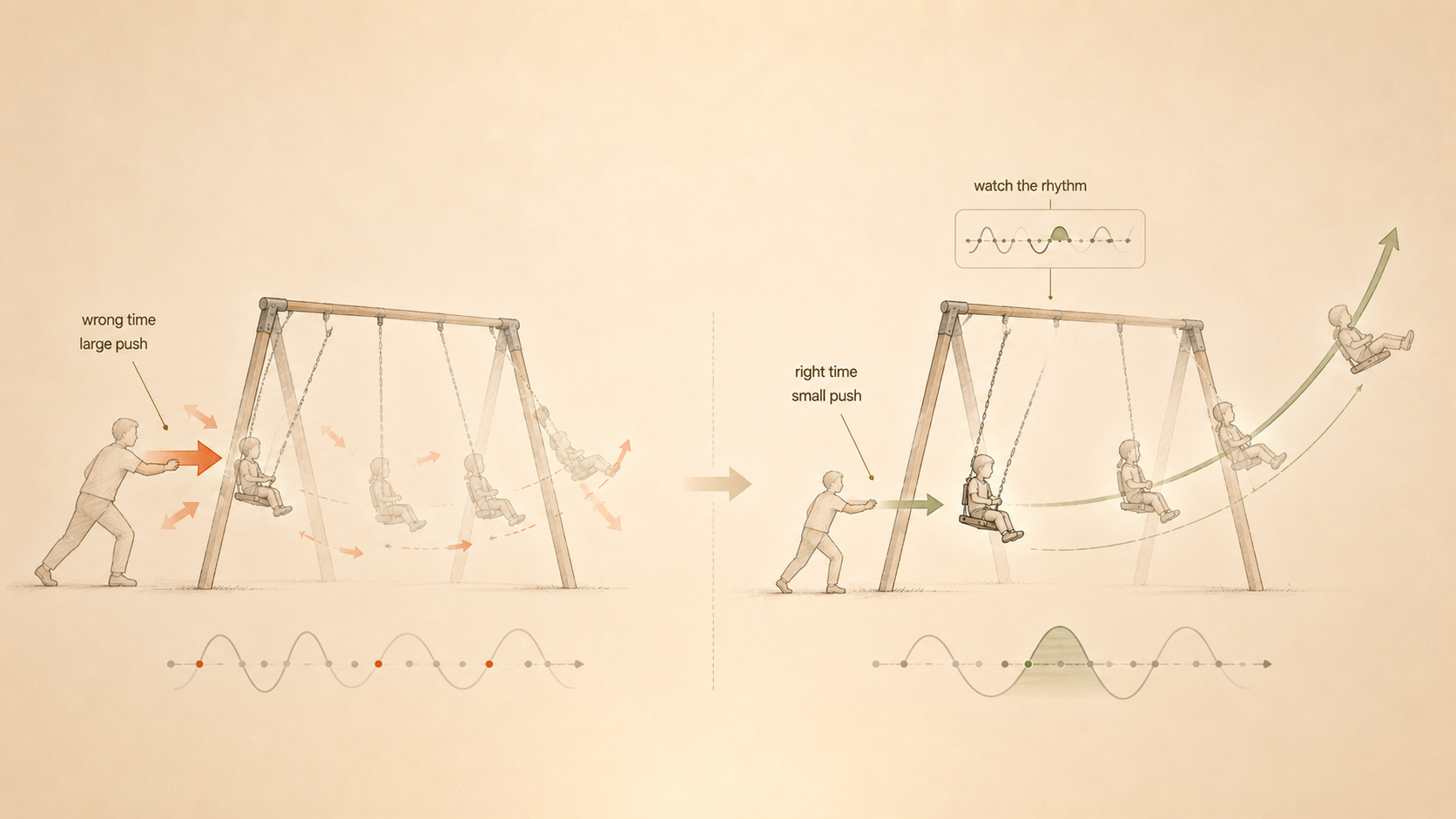
But a well-timed push depends on something else: you have to know where the swing is in its motion. You have to see its position, judge its direction, and act at the right moment.
So seeing and guiding are not separate problems. What you can detect affects when and how you can act.
That gives us the carrying question for this episode:
Are some difficult physical problems difficult because we need more force, or because the setup does not let us see and guide the system in the right way?
To follow that question, we begin with the equipment already sitting in the room.
Every camera, sensor, detector, computer, and control system is a physical machine. It has limits. It takes time to respond. It produces heat and noise. It needs power. It can only process so much information at once.
The machine that observes [observer] and the machine that acts [controller] are part of the physical situation.
That sounds obvious. But once we take it seriously, a chain of consequences follows.
The Record Is Useful, But It Is Not The Whole Event
Imagine a hummingbird hovering beside a flower.
To an ordinary phone camera, its wings may appear as a blur. A high-speed scientific camera can preserve individual wing positions, feather movement, and small changes in the bird's posture.
The hummingbird did not change.
What changed was the observing machine [observer].

Both recordings are real. Both may be useful. But each preserves different details because each camera has different timing, optics, processing, noise, and storage limits.
This gives us the first step in the argument:
Before asking only what the world did, ask what the observing setup was physically capable of catching.
Now take the idea one step further.
A song in a room is not originally a file. It is pressure moving through air. A microphone responds to that pressure. A recorder samples the response, assigns values, stores them, and may compress away detail.
The file is real. But it is not the whole room or every pressure change that occurred.
The physical event has been turned into a usable record [measurement as compilation].
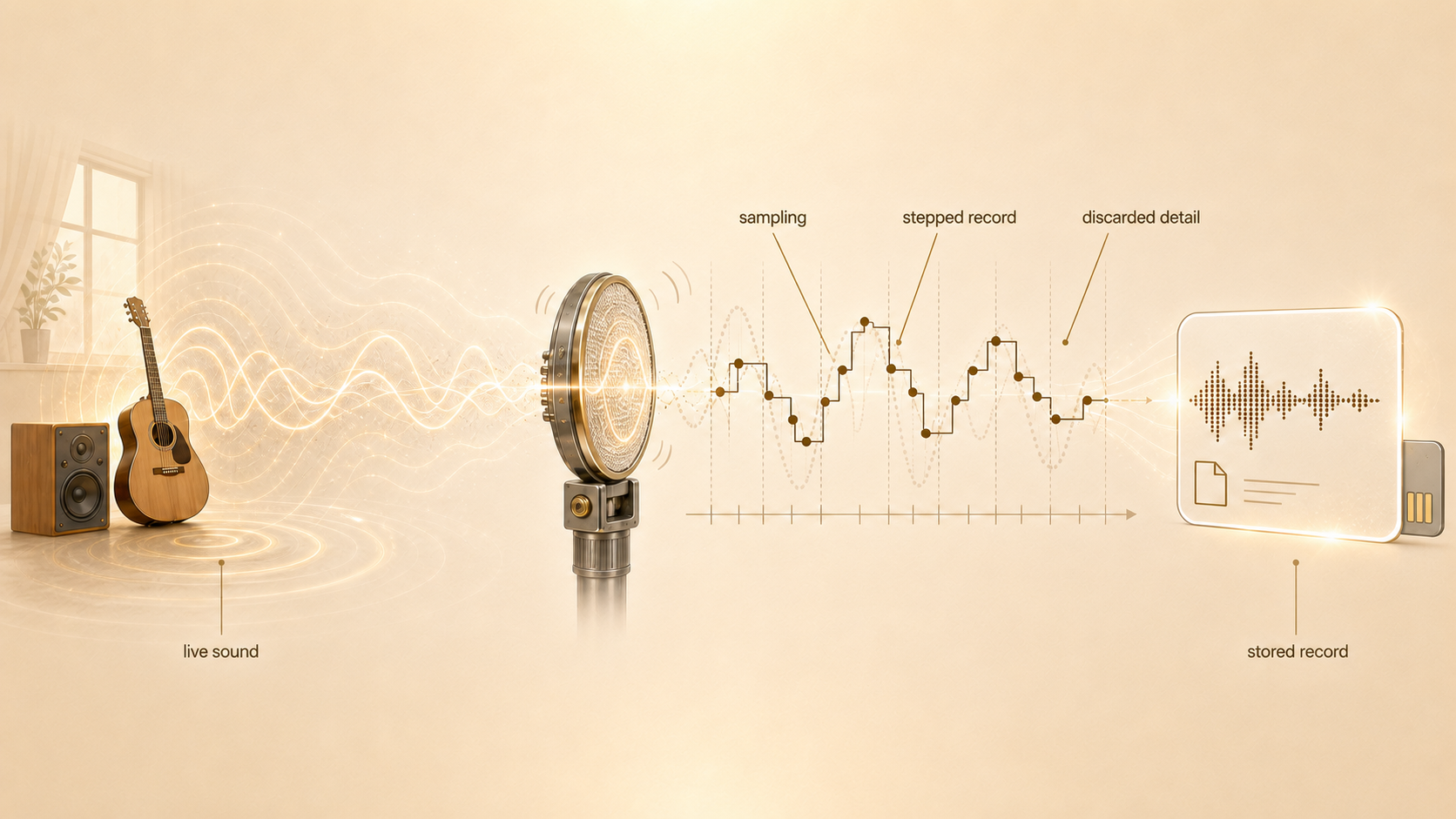
This does not mean measurements are fake. It means a record is made through a process. It carries information about the event, but it may also carry the limits and choices of the instrument.
This is where the name of the framework becomes useful.
It is called the Continuum Computation Thesis, or CCT.
Continuum refers to the connected physical process unfolding over time before an instrument divides it into frames, samples, clicks, or stored values.
Computation does not mean that the universe is a laptop. It refers to physical processes changing, holding patterns, and responding to feedback. The observing and acting machines participate in that process.
Thesis means this is the proposal being investigated: that physical evolution, observation, and control should be studied as parts of one connected process rather than as a world on one side and cost-free equipment on the other.
A pixelated mountain is still a mountain. We do not conclude that the mountain is made of square blocks. In the same way, a detector click, rounded number, or digital sample should not automatically be mistaken for the complete shape of the process underneath it.
So far, this may sound like a lesson about measurement.
But measurement is also the beginning of control.
A machine can only act on what its sensors make available. If an important change happens between two readings, the controller may react too late. If the signal is buried in noise, it may steer using the wrong information.
You cannot steer by detail your setup failed to capture.
And that creates the next question.
Can A Better Setup Reveal Better Leverage?
Consider a heart monitor.
The same beating heart can produce a jagged trace under one setting and a smoother trace under another. The filter may change. The timing window may change. Several beats may be averaged together.
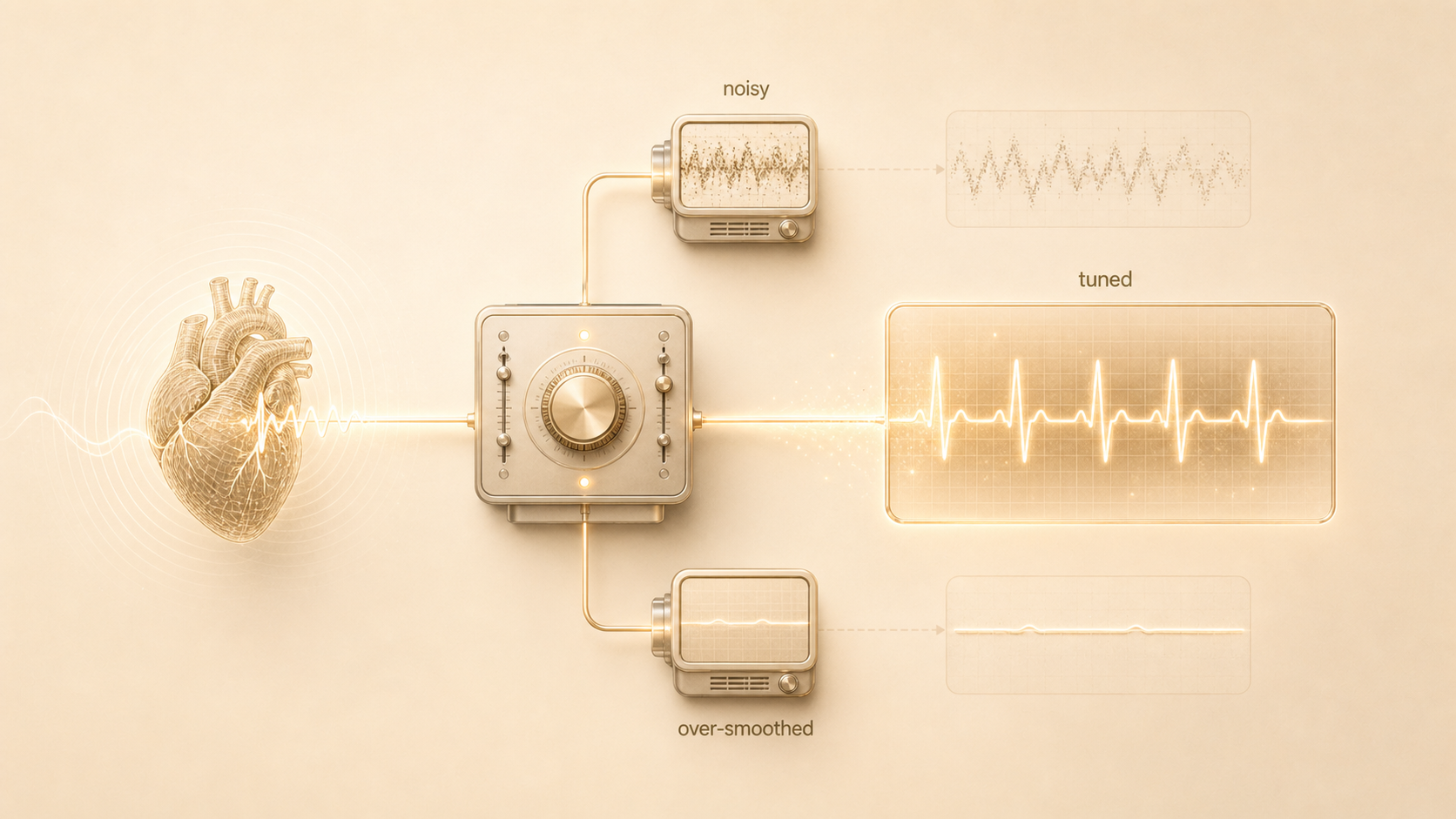
Which trace is the real one?
That is not quite the right question.
The heart may have changed. The machine may have become better at resolving a pattern. Or the cleaner shape may have been created by the filter itself.
The useful question is:
When we change the measurement setup, does the record change in a stable, checkable way?
CCT calls this the visibility or readability question [legibility]. Its technical test is the [Resolution Filter Hypothesis, or RFH].
RFH does not trust a graph simply because it looks cleaner. It asks whether the improvement follows a repeatable pattern and survives ordinary checks for heat, drift, saturation, software filtering, and environmental interference.
More data is not automatically better data.
Imagine photographing a dark wall with a camera that cannot gather enough light. One photograph may be mostly black with scattered sensor noise. Taking a thousand identical photographs gives you a thousand noisy images. It does not automatically reveal the wall's texture.
The problem is not the number of photographs. The setup is not capturing enough useful detail.
Adding light may reveal the wall. A sensor that works better in low light may reveal it. Combining several images may also help if the useful signal is present and the random noise changes between shots [incoherent averaging].
For changing or repeating signals, the setup may instead need to match its timing to the signal [coherent measurement]. The important point is that the improvement comes from changing how useful detail reaches the record, not merely producing more files.
If changing the setup can make a system easier to read, perhaps the same attention to timing, sensing, feedback, and physical arrangement can make it easier to guide.
That is the opportunity CCT is pursuing.
It searches for combinations of measurement and action that make useful states easier to detect, reach, hold, or recover [control grammar].
The wider engineering search for that physical leverage is called [programmable physics].
What Is Distinctive Here?
Many parts of this story already exist in established fields.
Scientists already study measurement limits. Control engineers already use feedback. Experimentalists already compare against baselines. Systems engineers already count support costs.
CCT is not claiming to have invented those practices separately.
Its proposed contribution is to connect them into one continuous route.
The observing machine, the acting machine, the record, the timing, the feedback, and the full resource bill are treated as parts of the same physical question. The same accounting follows a claim from its first measurement, through simulation and review, into hardware and eventually into larger engineering use.
So the distinctive bet is not simply that timing matters or feedback works. It is that a shared measurement-to-control discipline may reveal physical leverage that remains hidden when these questions are handled in separate specialist boxes.
But this is also where it becomes easy to fool ourselves.
A Good Outcome Is Not Automatically Good Control
Imagine a drone holding position in gusty wind.
It may look perfectly controlled. But what caused that stability?
Was it a well-timed controller? A larger battery? A sheltered pocket of air? A tether? Extra sensors? A powerful computer? Hours of calibration?
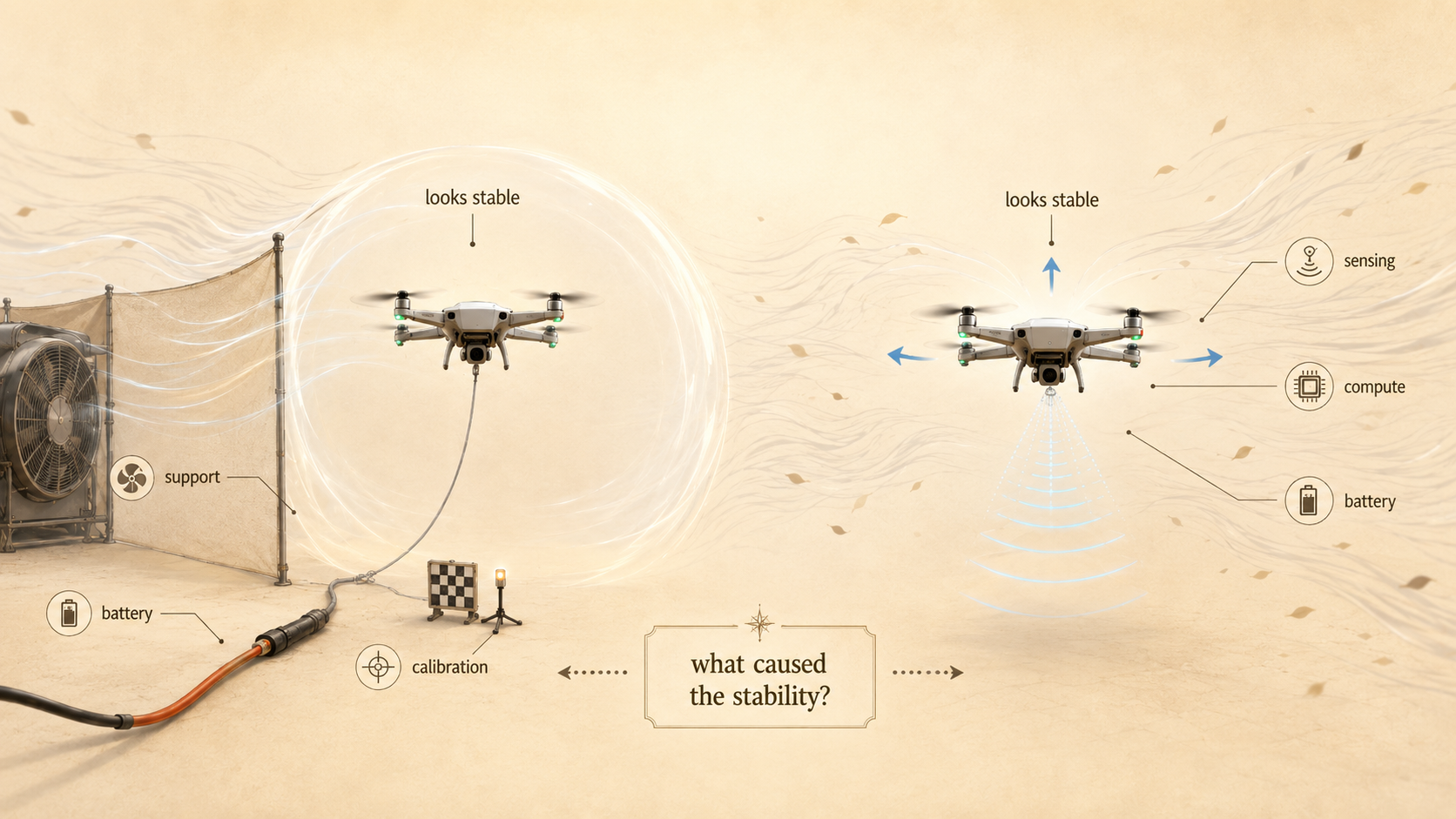
The visible outcome does not tell us who deserves the credit.
That is the difference between observing and controlling.
The observing machine [observer] reports what is happening. The acting machine [controller] spends energy to cause a change.
Control normally depends on observation, but it adds a harder burden: we must show that the intervention caused the useful result.
CCT therefore asks:
What useful steering did the energy actually buy?
Its technical gauge is [Prog_T], steering per declared resource over time.
Three parts matter.
First, the result has to help the actual task. Motion is not automatically useful steering.
Second, the controller has to deserve the credit. If the environment, a mechanical stop, or natural settling caused the result, that must be separated from the controller's contribution.
Third, the whole bill must be counted.
Sensors count. Computation counts. Cooling counts. Calibration counts. Timing equipment counts. Support hardware counts. If a tiny control signal only works because a refrigerator-sized cooling system sits beside it, the refrigerator belongs in the account [denominator / ledger].
This is the boundary around programmable physics.
The claim is not that a clever setup escapes physical cost. The claim is that a better setup may produce more useful control for the total cost paid.
And because that possibility is ambitious, it needs a route that is unusually hard to game.
How Does CCT Stop A Good Story From Becoming A False Result?
CCT uses a tightening sequence.
Each stage asks a different question, and each stage hands a narrower claim to the next.
First: Build A Small Rulebook
Before testing a complicated machine, CCT reduces the claim to a small, clearly defined game board.
What is being measured? What counts as success? What would the system have done without the intervention? Which costs must be included? What result would show that the claim failed?
These small, bounded rulebooks are called [Baby Theorems].
The word "baby" does not mean unimportant. It means the claim is deliberately small enough to inspect. Inside this stated setup, the rulebook identifies a limit, a required comparison, or a cost that cannot be ignored.
Suppose marbles naturally roll to the bottom of a bowl. If a robotic arm nudges them toward the same bottom and claims full credit, the rulebook asks what the marbles would have done anyway [baseline].
Suppose measuring a tiny drop of water changes its temperature. The disturbance caused by measurement has to be counted [back action].
Suppose a controller makes a route easier by reshaping the landscape around the system. That may be useful, but the work required to reshape the landscape belongs in the bill. If you bulldoze the hill, you must pay for the bulldozer.
These small examples isolate the logic before real hardware adds heat, vibration, leakage, drift, and many possible explanations.
If a claim fails in the simple sandbox, complexity should not be allowed to hide the failure.
Second: Turn The Rulebook Into A Stress Test
A rulebook identifies what must be checked. A simulation then asks whether the claim still looks promising when the checks are actually run.
CCT uses simulation as a harsh filter [simulation discriminator].
That filter has several jobs.
First, it decides in advance exactly how success will be measured [estimator]. Otherwise, a disappointing result can be rescued by quietly changing the scoring rule.
Second, it introduces ordinary problems: noise, timing errors, drift, calibration mistakes, heat leakage, delayed feedback, and uncertain starting conditions.
Third, it compares the proposed method with ordinary alternatives. If simple heating, random timing, or a basic controller performs just as well for the same resources, the new route has not earned an advantage.
Fourth, it maps where the idea appears to work and where it fails. The useful result is not merely "the simulation worked." It is knowing the conditions under which the advantage appears, weakens, or disappears.
Fifth, it writes the question for hardware.
That preparation is deliberately incomplete. A simulation can define expected failure patterns and rejection rules, but it cannot anticipate every way real equipment may fail.
A useful simulation should be able to give the lab a practical instruction:
Apply this kind of input.
Measure this feature in this declared way.
Compare it with this ordinary route.
Count these support costs.
Look for these failure boundaries.
That is why making a claim smaller can be progress. A broad idea can float forever. A focused question can be physically answered.
Third: Make The Reasoning Inspectable
Outsiders should be able to ask three practical questions:
Did the controller really cause the change?
Was the complete resource bill counted?
Did better observation become better control, or merely a cleaner record?
The strongest ordinary approach must be compared fairly [baseline]. Ordinary explanations that could dissolve the result must be tested [nulls]. The whole resource bill must remain visible [denominator].
The public layer should expose the rules used to judge the claim: the comparison, the accounting, the failure conditions, and the status the result has earned. Build-specific recipes and settings can remain protected.
These rerunnable public checks [public method artifacts] show whether the accounting and decision process behave as declared. Physical testing remains a separate step.
The same public route must also record what remains unresolved.
A simulation or method check is often not the end of a proof path. It is the point where the next question becomes clear:
Does this need a stronger theorem?
A counterexample search?
Specialist review?
A better no-effect test?
Or a real physical bench?
This living list of unanswered proof and test questions is the [Open Theorem Roadmap]. It stops the claim from quietly changing after a failure. Progress can mean a stronger proof, a sharper question, an ordinary method winning fairly, a clean stop, or a claim becoming focused enough to test physically.
Finally: Let The Physical World Decide
Selected claims must eventually meet real instruments and real materials.
Sensors drift. Equipment heats up. Detectors miss events. Materials vary. Delays appear. Support costs grow.
This is the role of [CCT Labs]. It is where selected claims leave the clean world of paper and simulation and meet physical equipment.
CCT Labs does not try to prove the entire worldview in one dramatic experiment. It takes one narrow claim at a time.
CCT Labs can test different kinds of narrow claims: whether a measurement change reveals a repeatable feature, whether a field arrangement holds a stable region, or whether a structured input controls a material without hiding support costs.
In each case, the laboratory begins by looking for the ordinary explanation: detector saturation, heating, leakage, timing delay, calibration drift, a lucky sample, or an incomplete support bill.
The result is not limited to "success" or "failure."
A route may survive and earn stronger physical status.
It may narrow to a smaller range of conditions.
The ordinary approach may win [baseline wins].
The decision may pause because the measurement is not yet good enough [defer].
Or the route may stop [no-go].
CCT Labs also creates shared procedures, comparison methods, cost records, negative-result formats, and test-bench designs. That gives different fields a common way to inspect what was tested and why the decision followed.
One Claim Through The Whole Route
Consider one generic claim: a carefully timed and shaped input can guide a material into a useful state more effectively than ordinary heating.
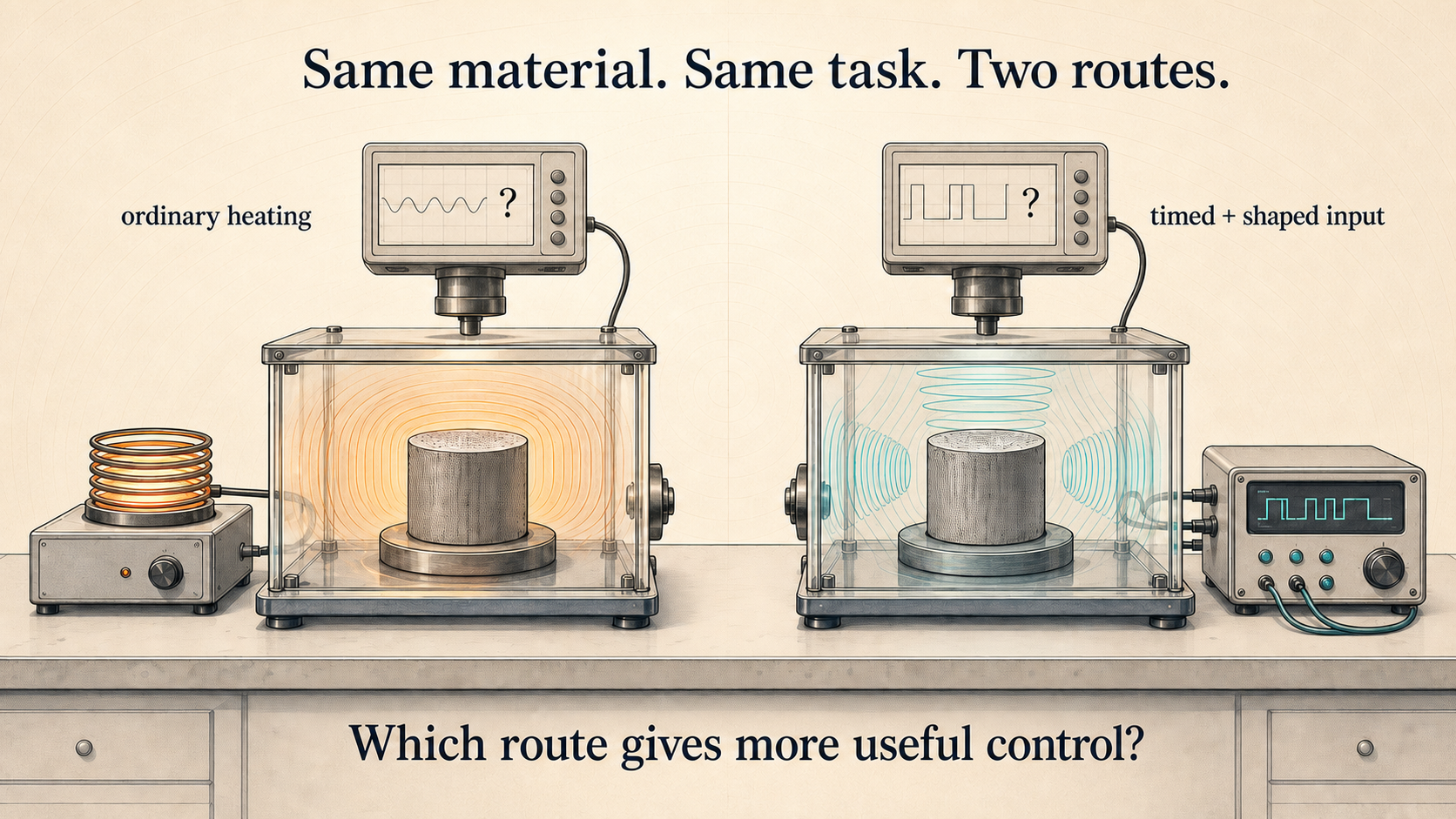
The claim begins with measurement. What counts as the useful state, and can the instruments distinguish it from simple heating or sensor drift?
The small rulebook then fixes the comparison. The shaped input and ordinary heating must be judged on the same task, over the same period, with the same full energy accounting. Any setup or reset cost must be included.
The simulation tries to break the idea. It changes the timing, adds noise and delay, compares random inputs, and maps where the apparent advantage disappears. Its output is a narrower question for hardware, not a declaration of success.
The public checks expose the scoring rule, the ordinary comparison, the no-effect tests, the support costs, and the result that would stop the route.
Then the lab applies the two approaches to real material. It checks whether heat damage, leakage, calibration drift, or a lucky sample explains the result. If the shaped input still produces more useful control for the complete cost, that narrow claim earns stronger physical status.
If ordinary heating performs just as well, the ordinary method wins. If the effect appears only inside a smaller range, the claim narrows. If the instruments cannot yet tell the difference, the decision pauses.
That is the whole CCT route in one example: see clearly, define fairly, stress the claim, expose the accounting, and let physical testing decide.
The path is therefore:
Bound the claim.
Stress it in simulation.
Expose the reasoning and accounting.
Test it physically.
If a route survives, it earns a narrower and stronger status.
If it fails, the claim narrows or stops. That is useful too, because it tells us where the map was wrong.
Now we can ask the larger question without skipping the evidence.
What Could Surviving Results Mean?
Suppose measurement, timing, feedback, and support costs repeatedly determine what becomes visible and controllable.
Then perhaps they should not be treated only as equipment details outside the main physical picture.
Perhaps they belong on the list of things that physically matter.
That expanded inventory is the deeper CCT picture [ontology].
Traditional engineering already tracks mass, force, heat, pressure, fields, and materials. CCT adds the observing machine, the acting machine, the record, timing, feedback, bandwidth, energy cost, and stable operating conditions.
This does not throw out known physics.
Known physics remains the anchor. Near-term work treats established laws and constants as fixed. The deeper question is whether different physical setups can support different stable effective behaviors while still recovering the physics we already know.
The theoretical map of possible stable behaviors is [rule space].
The physical, fully costed attempt to move toward a different stable behavior is [retuning].
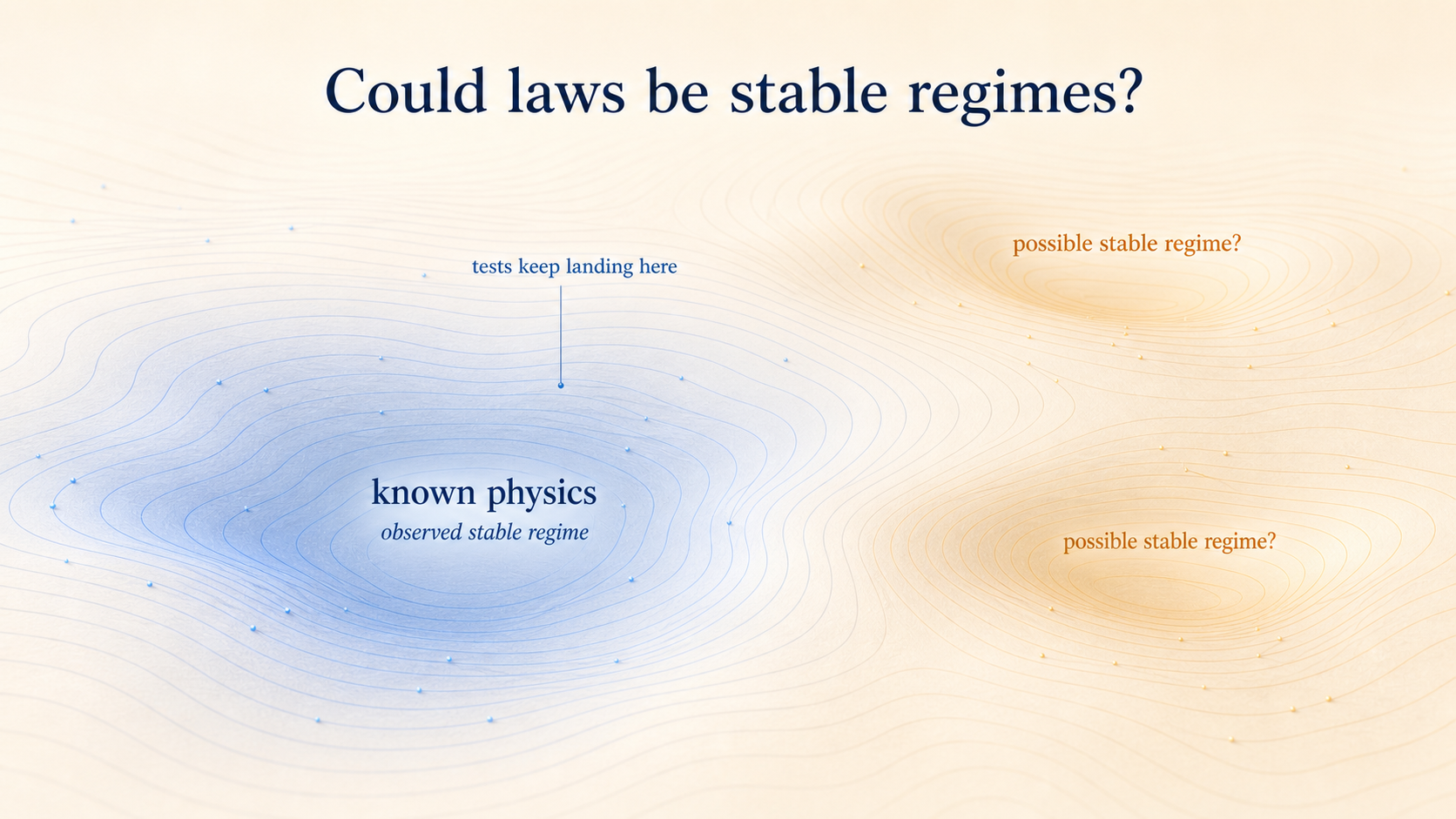
Again, there is no free switch. Changing a physical setup requires energy, sensing, feedback, stabilization, and heat management.
The deeper picture therefore does not replace the tests. It gives the tests a wider search direction. Evidence still decides what survives.
And that brings us to the furthest horizon of the program.
Tau X: What Changes At Mission Scale?
The episode began with one physical system, one observing setup, and one controller.
Tau X scales that same question up. What changes when the "setup" is an entire mission: vehicle, sensing, timing, correction, infrastructure, route, environment, and cost?
Spaceflight is one of the clearest examples of the push-harder problem.
A spacecraft must carry fuel, sensors, correction systems, power, shielding, safety reserves, and the fuel required to move all of that mass. Every added burden creates another burden.
Tau X asks whether the full mission can be designed as one connected physical system [Tau X].
What must remain on the vehicle?
What could be supported by timing references, distributed sensing, communications, correction infrastructure, service points, orbital structure, or environmental conditions?
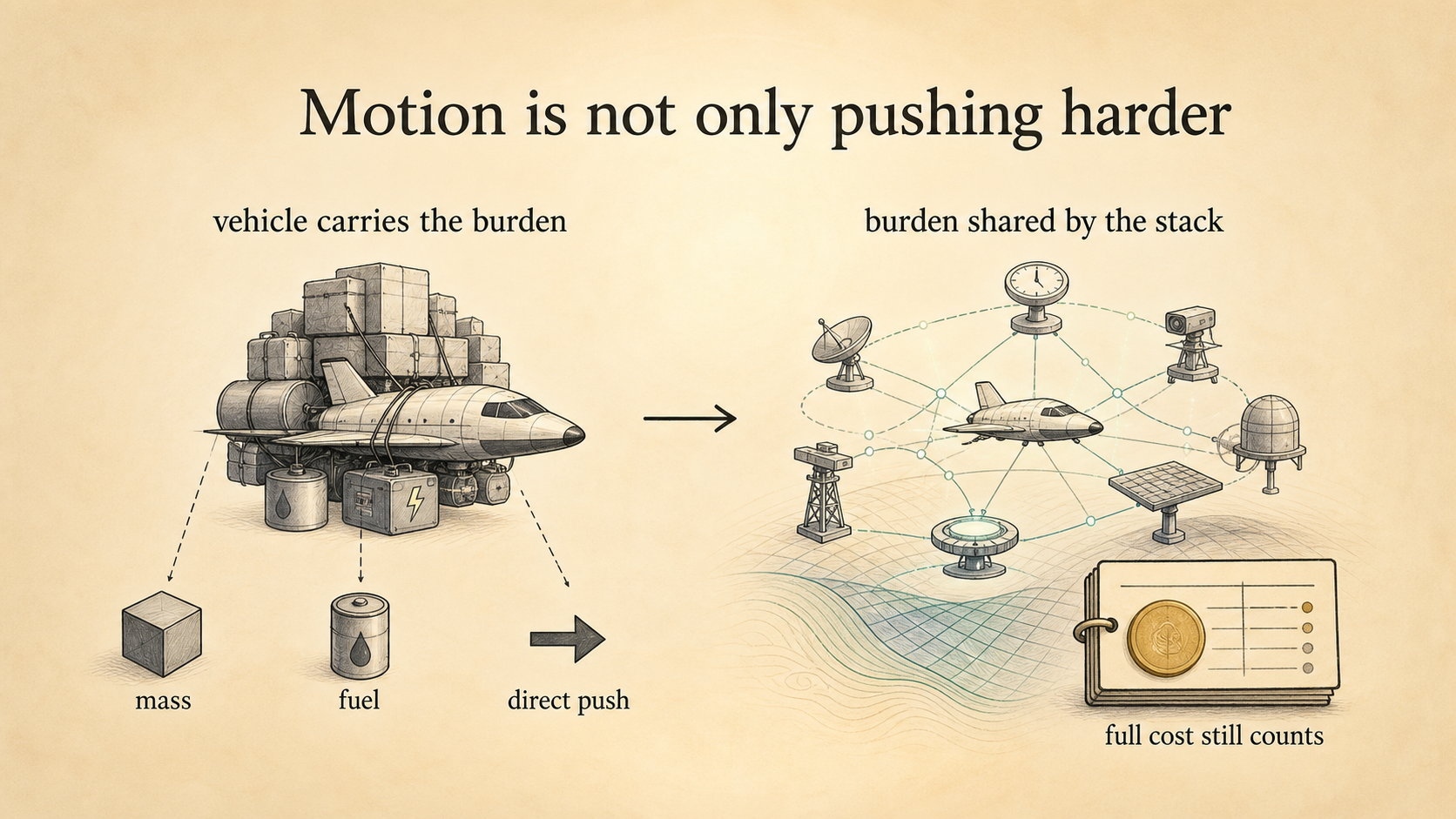
Moving a burden off the vehicle does not erase its cost. Relay launch, maintenance, synchronization, delay, correction, and failure recovery all belong in the mission bill [mission ledger].
But the location of the burden matters.
A mountain peak two miles away can be practically distant if the climb is severe. A town fifty miles downstream can be practically close if the current carries you.
Tau X uses the same idea for missions. The question is not whether distance magically disappears. It is whether the wider mission setup can make some states, routes, corrections, or recoveries easier to reach [effective adjacency].
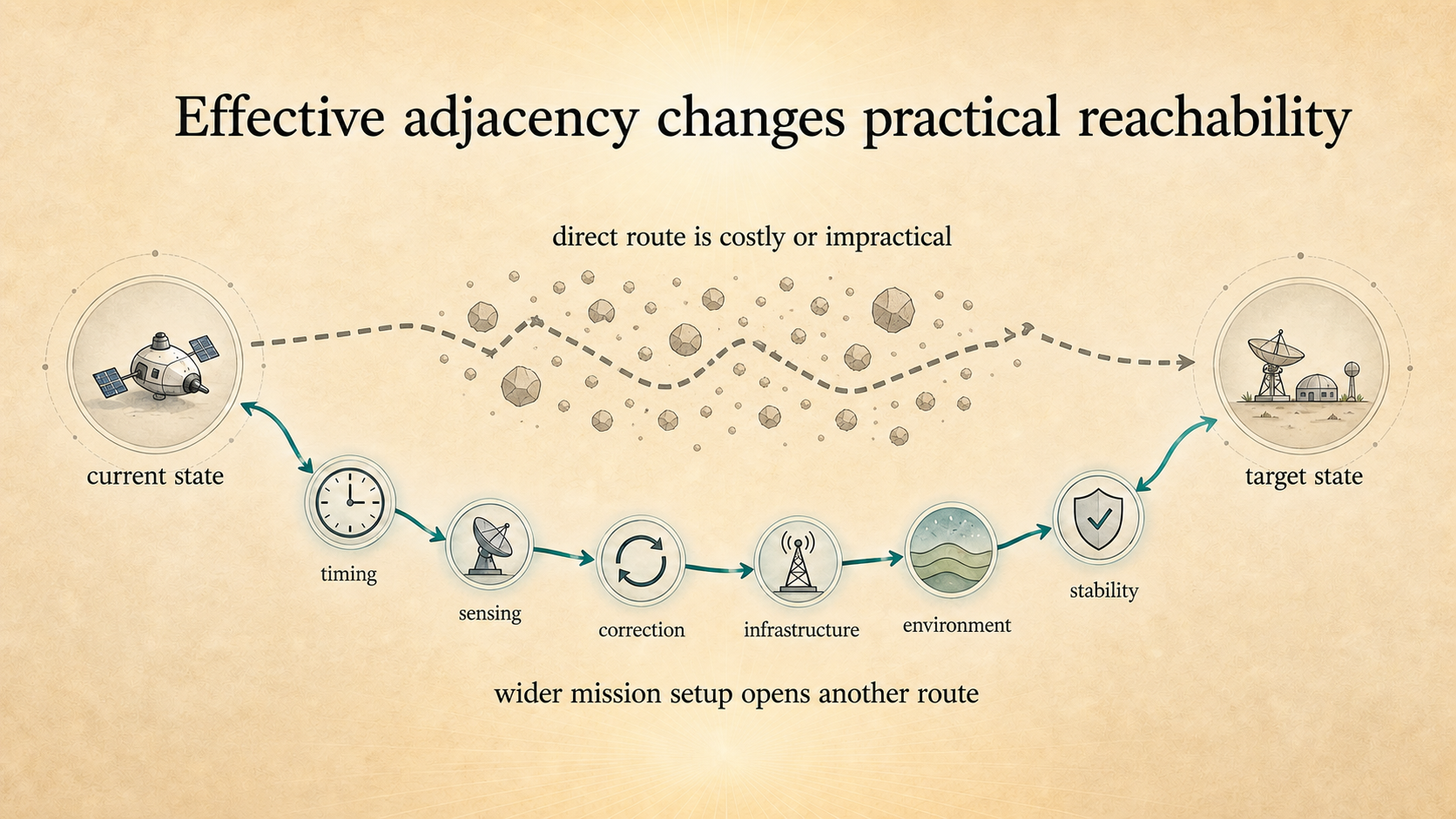
This is why Tau X belongs at the end of the CCT story rather than the beginning.
It inherits only what survives the earlier route: better seeing, better timing, attributable control, full accounting, simulation stress, and physical exposure.
The moonshot comes from disciplined seeing.
Where The Work Stands Now
CCT is currently a staged research program moving from formal questions and runnable method checks toward selected physical tests.
The theory layer has defined the main questions, resource limits, and bounded rulebooks. Some of those checks can already be run on controlled examples.
The simulation and public-method layers can test accounting rules, compare routes, expose hidden costs, narrow claims, and produce specific questions for hardware.
The next stronger physical status has to come from physical exposure. Selected measurement and control claims must survive real instruments, materials, drift, noise, full cost records, and replication through [CCT Labs].
The deeper physical picture [ontology] and the Tau X mission horizon remain search directions guided by whatever narrower results earn that stronger status. They do not borrow hardware status in advance.
Its present contribution is a connected research route: formal questions, runnable method checks, simulation-to-bench targets, and a declared path toward physical testing. Stronger physical claims must be earned at the next stages.
Closing
So why have the CCT discussion?
Because engineering often treats the equipment around a physical system as secondary: the sensor observes, the controller acts, and the support machinery sits outside the main story.
CCT asks what changes when the whole setup becomes part of the physical question.
Can we see the system more reliably?
Can we guide it more effectively?
Did the controller cause the result?
Was the whole bill counted?
Can the claim survive attempts to break it and contact with real hardware?
If the answer is no, the route narrows.
If the answer is yes, we may have found a piece of physical leverage worth carrying into another system, another field, or eventually another kind of mission.
CCT is therefore not a promise that every problem yields to clever timing, and it is not a finished replacement for physics.
It is a disciplined search for places where better seeing, timing, coordination, and control can achieve what more force alone cannot.